Ask any computational biologist about reproducibility and you'll get a slightly pained smile. We all believe in it. We all know the feeling of opening a year-old project and discovering it no longer runs.
The uncomfortable truth is that reproducibility usually fails for boring, mechanical reasons — not scientific ones.
Why analyses stop reproducing
- Environments drift. A package updates, an API changes, and code that worked in March throws errors in November.
- Steps live in people's heads. The "real" pipeline is a mix of a script, three manual tweaks, and a thing someone did once in the terminal.
- Versions go unrecorded. "Latest" is not a version. Six months later, nobody knows what "latest" meant.
- Figures and numbers diverge. The plot was made from an earlier run than the table. Nobody notices until a reviewer does.
Reproducibility isn't a virtue you summon at submission time. It's a property you either build in from the first run, or spend weeks reconstructing later.
Capture the whole run, not just the code
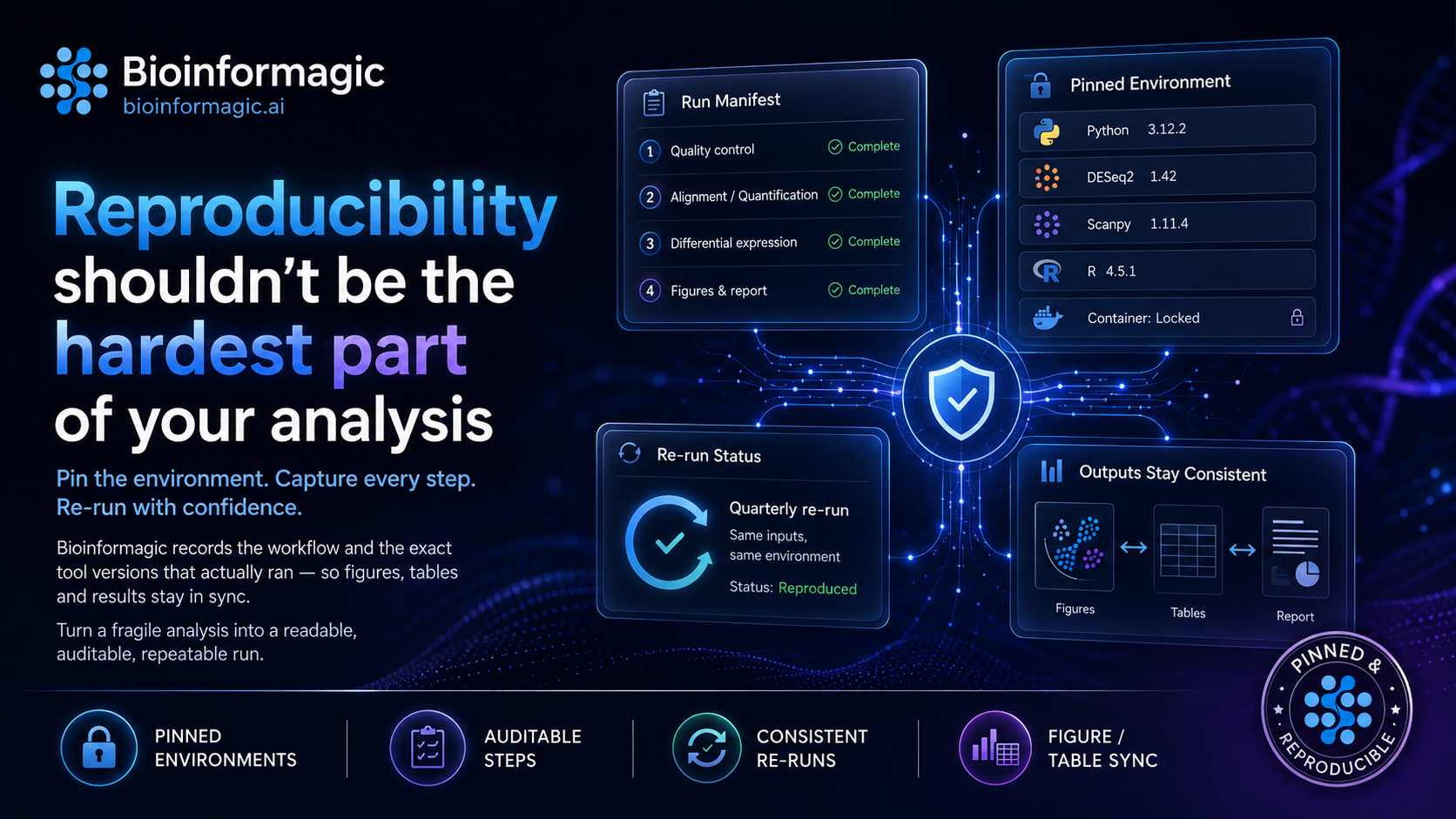
A script alone doesn't reproduce an analysis; the environment around it does. Bioinformagic treats both as one artifact. When a workflow runs, it records the steps and pins the exact tool versions they used, so the run is described completely — not just "what I typed" but "what actually executed."
A readable manifest, not a mystery
That record is meant for humans. You can see, in plain language, which steps ran, what parameters they used, and which versions were involved. It's the difference between "trust me, it worked" and "here is exactly how it worked."
Re-running becomes boring (in a good way)
When the environment is pinned and the steps are captured, the scary tasks get small:
- Re-run an analysis from last quarter — it uses the same versions, so it behaves the same way.
- Add a sample and regenerate every figure — the workflow re-runs end to end, consistently.
- Hand the project to a labmate — they get the steps and the environment, not a folder of riddles.
Reproducibility as the default, not the deadline
The goal is simple: make the reproducible path the easy path, so you get rigour without thinking about it. You describe the analysis; the captured, pinned workflow is just a by-product of doing the work — exactly when you'd want it.
See it on a real project
If "can you re-run that?" has ever ruined a week, this is for you. Join the early-access list and put a finished analysis through it — then try to break the re-run.