There's a piece of advice every wet-lab biologist eventually hears: "you should learn to code." It's well meant, and it's not wrong. But somewhere along the way it hardened into a toll — as if analysing your own data requires first becoming a part-time software engineer.
It's worth asking whether that's actually true, or just an accident of how our tools grew up.
The gap nobody designed on purpose
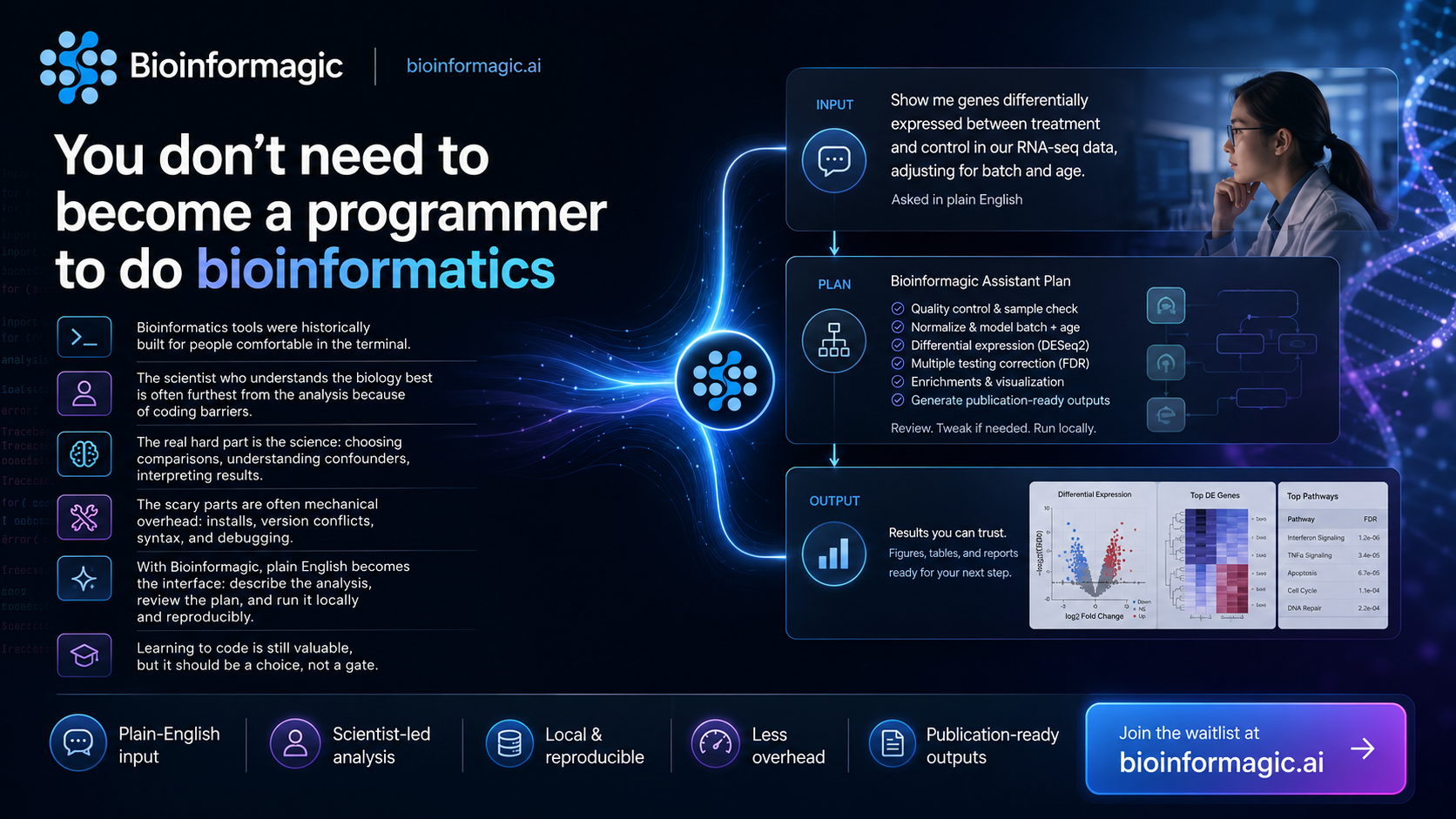
Bioinformatics tooling was built by and for people comfortable in a terminal. That made sense historically. But it left a gap: the person who designed the experiment, generated the samples, and understands the biology most deeply is often the person least equipped to run the analysis.
So the work gets handed off — to a collaborator, a core facility, a queue. And every handoff adds latency, telephone-game misunderstandings, and a little distance between the scientist and their own results.
The person who understands the biology should be able to interrogate the data directly — not wait in line to ask someone else to do it.
What's actually hard, and what just looks hard
Here's the thing worth separating out. The hard parts of analysis are scientific: choosing the right comparison, understanding confounders, interpreting an ambiguous result. Biologists are already good at these.
The parts that feel hard — and that scare people off — are mostly mechanical: installing tools, resolving version conflicts, remembering syntax, debugging an error message that has nothing to do with biology. That's not insight. That's overhead.
Plain English as a real interface
If you can describe an analysis precisely to a colleague, you already have the hard skill. Bioinformagic treats that description as the interface: you say what you want, review the plan, and run it — locally, reproducibly. The code still exists underneath, and you can look at it any time. It's just no longer the price of admission.
Learning to code is still great — when it's a choice
None of this is an argument against learning to program. It's a fantastic skill, and many researchers will still want it. The argument is narrower: analysing your own data shouldn't be gated behind it. Curiosity, not a compiler, should set the pace of your science.
Close the gap on your own terms
If you've been putting off an analysis because it meant a coding project you don't have time for, you're exactly who we built this for. Join the waitlist and start with a question you already know how to ask.